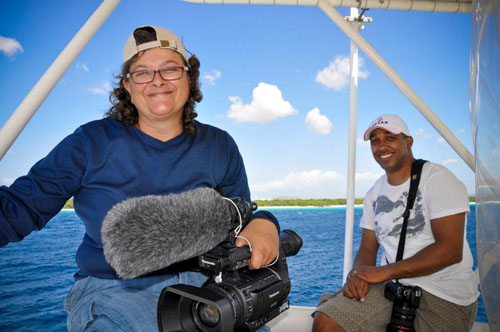
 VA: You are well known in the field of documentaries and film in Aruba having produced several yourself. How did you get involved with the Aruba International Film Festival and the Caribbean Spotlight Series specifically?
RR: Last year was the first year the Caribbean Spotlight Series was set up the way it is now: a competition with about 7 Caribbean Films, and all the filmmakers present. Aaron Hosé, another Aruban Filmmaker, Emmy Award winner, and residing in the States was (and still is) the CSS Program Director. Aaron was looking for people to make up the selection committee. He got my name from someone and gave me a call. It took some convincing at first, but he won me over. Initially I was only supposed to be part of the selection committee, meaning watching the movies that are submitted and then reviewing them. But once the festival came around, they needed a bit more help during the CSS weekend, so I ended up helping around during the festival too and leading most of the Q&A’s between audience and filmmakers after the movies. Before the festival was over Aaron and Jonathan Vieira, the festival's executive producer and founder, asked for a commitment for the 2012 festival which would be more on the logistical side of it all.
VA: What is the main philosophy and aim of the CSS?
RR: The official mission is:
“...to highlight and reward the work of talented local and Caribbean filmmakers, and to provide a platform for networking opportunities with fellow Caribbean peers as well as industry professionals from around the world. The films for the AIFF Caribbean Spotlight Series aims to bring the finest in new Caribbean cinema to Aruba, giving filmmakers the chance to go head-to-head for cash prizes. The AIFF CSS committee and jury will consist of local and Caribbean filmmakers, AIFF staff, representatives from prestigious international film festivals, and members of the local press.”
Showing feature-length films of the region in a competition – an audience award and a jury award is given - and by bringing over the filmmakers of the selected films creating an environment in which Caribbean and Aruban filmmakers – also the aspiring ones – can meet each other, exchange ideas and network. Also by specifically focusing on Caribbean films, we hope to show stories that are more identifiable for the audience. You have to remember, these are films that will hardly ever reach mainstream distribution. And even if you are actively looking for them it is hard to find them on DVD.
VA: Is it challenging to find enough suitable selections or is it difficult to narrow down the selections from the submissions you receive?
RR: Both. The challenge for me is mainly in the definition of “Caribbean”. If we look at ourselves, we can honestly say that though Aruba is a Caribbean island, the Latin and (Dutch) European influences are big. Finding the films and getting submissions from those we do not know, though hard work, is less of a problem than we foresaw. We have a team that is always on the look out for new Caribbean talent, Aaron and I visit other film festivals whenever we can, and due to the success of last year’s festival, people have come to us. Still, there are a lot of films to be viewed and sometimes you have to turn one down based solely on the submission criteria. For example, we had to deny entry to a Caribbean short film, and it is now an official selection at Cannes (the biggest film festival in the world). We just do not have the resources yet to open it up to short films. But we can certainly dream, and aim for more categories next year.
VA: It is evident that the submissions must have a Caribbean subject, but what are the main criteria for actually being selected to participate?
RR: Well we actually have two main programs. The Caribbean Spotlight Series “competition” which is for feature length films (50 – 120 minutes) that can be either a fictional narrative or documentary. All the films must have a Caribbean subject matter and/or the filmmakers must be of Caribbean heritage or based in the Caribbean.
We also have the Aruba Flavor competition, which is a separate program exclusively dedicated to fostering the talents of local filmmakers. These Aruban films are mainly shorts. They will be shown before the CSS feature films. The jury will then recognize their preferred Aruban entry with the Best Aruba Flavor Film award.
VisitAruba.com note: There are several specific criteria for CSS submission that can be found on the AIFF website.
VA: Who will be the judges for the 2012 CSS and aside from the judges opinions, what in your view determines a successful CSS film?
RR: For the audience award, the audience is the judge. Before every CSS showing you will be given a ballot on which you will cast your vote. The highest scoring film will win the audience award. Last year our winner was “Children of God” by Bahamian director Kareem Mortimer. We have invited Kareem to be a jury member this year. The other jury members have not yet been confirmed, but they will also be film professionals. They can be other filmmakers or even film critics.
And “What determines a successful CSS film?” The obvious answer would be the ones that win the awards! But I think that is too easy. Last year I think one of the most successful films was “Curaçao”, though it did not win an award. People either loved it or hated it. But it did ignite a lot of debate, not only about the subject matter, but also about whether or not such a subject could be tackled by European Dutch filmmakers if they had enough sensibility to the subject matter. So there were discussions all over about a lot of different things. And I think if a film causes that, then it can be considered successful. Today people still approach me asking if I know “how” they can get their hands on a copy of that film because they had heard so much about it. And I can go on and give examples about all the films that were selected. So trust me: all the films screening in the CSS are worthwhile.
VA: What could a winning selection hope to achieve aside from the cash prize?
RR: The Aruba International Film Festival has done something few festivals before it have done; that is, gather a lot of international press from the very first installment (this is its 3rd edition). So by getting into the AIFF you are assured attention by the international press. Furthermore, by screening in a respected festival (which AIFF is), this puts you in the eyes of other festival programmers and members of the film industry. To give an example: our own Francisco Pardo had the world premiere of his short “10 Ave Maria” at last year's AIFF. Its success here caught the interest of the Trinidad & Tobago Film Festival. Subsequently, the festival there awarded “10 Ave Maria” the Jury Prize for Best Short Film. Since the CSS and Aruba Flavor competitions are professionally modeled after other prestigious film festival competitions (not every submitted film gets in), adding the AIFF’s “official selection” laurel to your film will certainly increase its overall visibility.
VA: Have there been any success stories following the screenings at last year’s CSS?
RR: I already mentioned Francisco Pardo just now. And I must add that Ryan Oduber was co-director and director of photography on “10 Ave Maria”. Ryan was also Director of Photography on the film that won last year’s Aruba Flavor jury award, “Muhe Frida”. This film has also been selected to other international film festivals since screening at AIFF. There are of course more films from the CSS competition that have since screened at other festivals. And Kareem Mortimer, I believe, is a director we have to keep our eyes on. I am sure that soon we will see some big studio film directed by him.
But I think the biggest success of the CSS—and the festival as a whole—is the way it has motivated people, especially here in Aruba, to make films. Last year the Aruba Flavor competition had only two selections that were of “film festival quality”. This year the submissions have run into the double digits. It will be quite a feat to make a selection from these as our space is limited and the quality is much higher than you would suspect with so many entries from such a small country.
VA: In what ways will the CSS of 2012 improve upon previous years’ events?
RR: Well, the fact that we have more submissions – especially locally – ensures that the selections will be of higher quality and more diverse in subject matter. Not only that, but this year we have also managed some great festival feats. Just recently we announced our first two CSS competition films. Of these two, “Children of the Wind”, a documentary about the amazing Bonairean Windsurfers that are the top in international freestyle, has chosen our festival to host their World Premiere. “Pelotero”, a U.S.-produced documentary about young Dominican ball players dreaming of a better life through baseball and a lucrative contract with the MLB, will have its International Premiere in Aruba (meaning, the AIFF is the first venue outside the USA to screen this film). For a film festival—as opposed to a “showcase”—you are always looking for new films, new talent, and to have the filmmakers present. You want people in the industry to wonder, “What is Aruba doing now?” Just with these two films alone we have achieved this in a big way. And we haven’t even revealed the rest of the selections yet. From here on out, the festival will only grow. Another film we announced is one selected for Aruba Flavor: the animated short “Wake Up” by the super-talented Ken Wolff. The final selection will be announced by the end of the month by the way.
VA: What do you find to be on the one hand the most challenging and on the other hand the most rewarding or fun aspects of the CSS?
RR: Challenging… where to start... I think, as all of us in Aruba can relate with, that having to “wear multiple hats” as just one person is very challenging. But that is the name of the game here in Aruba, no matter what line of work you are in. The most fun is in the end, when you can kick back and say that this is a great festival that you yourself would travel to. But the most rewarding part is that this festival, and especially CSS and Aruba Flavor, is completely run by Arubans. Starting with the festival's executive producer and founder Jonathan Vieira, to the last person on the team (and if they do not have a Dutch passport, they are likely long-term residents of Aruba). Since we are all Arubans, this just makes us want to work harder and create a festival that the island can be proud of and the region looks up to! Next up… the world!
Something I want to add… did you know that a great number of international film festivals are organized by journalists/writers, art curators, professional event producers, and film lovers? What’s interesting about our festival is that most of the people involved in key positions are active filmmakers and producers (including Jonathan Vieira). So we “know” the hard work it takes to produce a movie, let alone a good one. And we also know “what” it feels like to participate at a festival with our own film and be welcomed with open arms by the organizers. Having had these experiences, we want to try and bring this to filmmakers attending our festival. I do think this adds to the great atmosphere visiting filmmakers encounter at AIFF. Plus our Aruban hospitality certainly helps too.
VA: For 2012, a lot of the satellite entertainment at the AIFF has already been announced with big musical talent in attendance, but in terms of movies, actors, directors and industry attendance there have been no announcements yet. With the festival just over a month away, can you give us any insights into what movies will be screened and who might be attending?
RR: I cannot speak for the main AIFF program, which has brought in the big names the last two years. Our festival director, Claudio Masenza, is currently finalizing details for the main program. Claudio previously worked for the Venice Film Festival (one of the big four, the others being Cannes, Berlin and Toronto), and now also works for the young Rome Film Festival, which is quickly becoming one of the hottest venues on the international film festival circuit. But I can say that this is not unusual for an international film festival. Most festivals announce their final programs 2–4 weeks in advance. There are a lot of logistics involved and especially when thinking of big name stars with a new film, they have so many obligations that sometimes it is hard to find time in their schedule. You do not want to drop a name and then last minute discover they have other obligations. But I can say that I have heard some interesting names mentioned. I am as curious as you to see who will be here.
In the mean time you can rest assured that we of CSS will give you a spectacular first weekend in which you can see seven Caribbean films that you will not be disappointed in.
On behalf of VisitAruba.com we would like to thank Rebecca Roos and Aaron Hosé for their contributions to this Q&A. We’re looking forward to the festival!