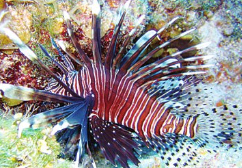
courtesy of: The Morning NewsMost diving enthusiasts have been made aware over the past five years of a beautiful to behold but serious threat to delicate reef systems throughout the Caribbean: the invasion of Peterois Volitan, the common Indo-Pacific Lionfish. Scientists speculate as to why this voracious predator was first spotted off the Florida as far back as 1985; most believe it is due to fish collectors letting them out to sea once they become too large for their tanks or possibly have devoured all their other fish. It is also believed Hurricane Andrew contributed by destroying homes with fish tanks housing the Lionfish and thus releasing them into ecosystem.
Whatever the cause, this species of lionfish native to the Indo Pacific, where there is a natural control of the population, is thriving and dominating Atlantic and Caribbean waters and reef environments. Last year, they were spotted in Aruba. Which is a cause of great concern for local marine biologists.
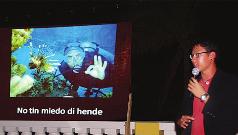 On Friday, August 13, The Hadicuari Fishing Center conducted a lecture by Adeljean L.F.C. Ho of Aruba, who graduated Magna Cum Laude from Roger Williams University in 2008 and obtain his Masters Summa Cum Laude from the Florida Institute of Technology. Presently he is working for his doctorate in Marine Biology from FIT. Adeijean explained the life cycle of the Peterois Volitan and why it is such a treat to the local marine environment.
The Common Lionfish is a voracious creature, and figures have shown that a single lionfish is capable of reducing the existing fish population of a reef where they have establish territory by 2/3 to 80% within a year. Lionfish are also very cunning hunters, often pursuing their prey in pairs or packs, herding fleeing fish towards each other so they cannot escape.
A pair of lionfish reproduces at a prodigious rate; those having taken up residence in the Atlantic will spawn clusters of eggs for 3 months out of the year, when waters are warm. Since the water temperature in the Caribbean is always high, those that have spread to local waters will reproduce all year round, with the capability of releasing 2 million fertilized eggs into the sea, annually. Within 24 hours, the larvae hatch, and within 20 to 35 days the young lionfish have matured sufficiently to return to the reef where they were spawned, or he carried by currents to invade new environments.
Dr. Byron Boekhoudt of the Centro di Pisca Hadicurari reports 20 sightings around Aruba’s dive sites; it is believed there have been many more, but often divers are not concerned or taking the time to report where the lionfish was seen “because they thought it was just too beautiful to be a threat.”
It is well known lionfish are venomous: the venom injected from their fins can be quite painful and particularly harmful to those who are allergic. However, the lionfish is NOT poisonous to ingest and Adeljean reported they are quite good eating.
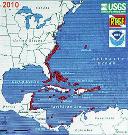 The Bahamas, which has greatly suffered from the lionfish invasion, retaliated by establishing fishing competitions directed at the species and several restaurants carry it on their menu. Officials here are considering such actions; Friday’s lecture was aimed at local fisherman, to encourage them to pursue lionfish, with instructions on how to catch them safely.
Capturing lionfish is actually quite easy as they appear to have absolutely no fear of man, which would appear as a large predator, as is normally witnessed with most species.
Adeljean admitted that scientist believe that eradication of the lionfish is unlikely; the object now is control and preservation of the local reef and fish species. Lionfish have been found as far north as Rhode Island and are firmly established around the waters of Colombia. The Centro di Pisca Hadicurari has distributed forms to all dive operators, asking any who have sighted lionfish during their dives b fill in and submit the information.
Location, time and depth are all very important facts which must be noted when reporting a sighting; the center asks that divers and snorkelers to do their part in helping Aruba to control this menace to the local marine environment.
The center’s offices are located on the second level between MooMba Beach Bar and the Marriott Surf Club: inquiries and assistance are welcome. Call tel. 586-6610 and ask for Francisco Franken.