 courtesy of: Aruba-Daily News
The Florida Fish and Wildlife Conservation Commission is very concerned about the Lionfish invasion in the Florida waters. This predatory fish called the Lionfish has become established in marine waters of the southeastern United States and Caribbean, and may spell trouble for many marine fish. The precise date and year that the Lionfish was first seen in the Florida waters is not clear but one thing is sure, since the early 1990’s the Lionfish populations have increased since then, and the species has been spotted as far north as the waters off Rhode Island in the Atlantic and in the warmer Gulf waters off Louisiana.
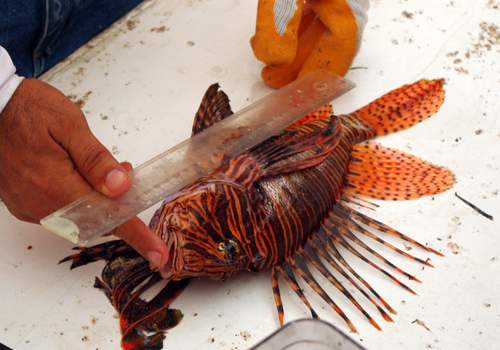
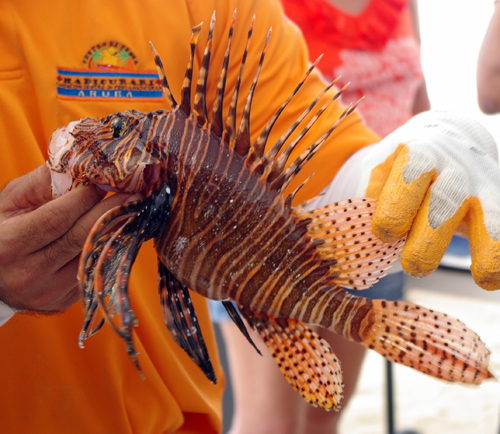
Also not sure if this invasive species was originally introduced in marine waters through the aquarium industry, the fact remains that it has arrived and is here to stay. Since then the Lionfish have become established on the United States East Coast and have expanded throughout the Caribbean. Scientists believe that Lionfish juveniles are carried by ocean currents and this ends up affecting other countries. The colorful predatory fish, which is native to Indo-Pacific waters, gets 12 to 15 inches long and has a high reproductive potential. The females can spawn several times per month and release up to 30,000 eggs every four days per spawn. As Lionfish grow, they switch their diet from invertebrates to fish, and this is where it becomes a major concern for islands like Aruba. The Lionfish eats native fish and are competing with native predatory fish such as groupers and snappers. The Lionfish also has a negative impact on overall reef habitat, since they feed on herbivorous fish that keep the algae in check on the reefs such as juvenile parrot fishes, tangs or surgeon fishes. The Aruba Marine Park Foundation has been involved since mid 2010 with the national control plan for the Lionfish. According to the foundation, the best thing to do right now is to remove this fish as much as possible from the waters around Aruba. The problem is becoming bigger because not only does the Lionfish spawn locally, but from the Venezuelan peninsula of Paraguana, which is only 6 miles to the south of Aruba and from Curaçao 56 miles east of Aruba the Lionfish larvae or juveniles can travel with ocean currents to Aruba, there for adding to the problem. The Aruba Marine Park Foundation has organized a Lionfish derby in March of 2011 because of the increasing numbers of this invasive species but this just showed that this fish is becoming more and more visible everywhere around the island. With the recent numbers surveyed on the island of Curaçao, it is estimated that with a good culling program on the sister island; they would be able to remove approximately 100,000 Lionfish per month. In Florida during one tournament 531 Lionfish were removed in one day. This is also proof that this is the only effective way to control the spread. Experiments with groupers and green morays feeding on the Lionfish are encouraging but removal by massive numbers is the way to go. Lionfish have venomous glands in their dorsal, pelvic and anal spines. They should never be handled with a bare hand.
Even when the fish has died, it can still cause the venom to be injected if you get stung accidentally by the spines. The concern of the many is the increasing sightings of Lionfish in shallow waters near the hotel areas. The fish doesn’t “jump up” and attack someone but they are not shy and will hold their ground. The Lionfish can swim in the shallow waters near the hotels and realistically one should not rule out possibility for injury. It’s not a reason for panic but we should not ignore the fact that they can get near people. For scuba divers this is not an immediate threat unless the diver tries to touch the Lionfish. For fishermen however this can be a problem if they are fishing with nets or catching bait fish because the Lionfish can get tangled up in the nets.
The government of Aruba should take this threat seriously because this is not just affecting the environment, but it will become devastating for the fishing industry as a whole, the tourism industry, health care, economy and the island in general. In the Bahamas the invasion was not taken serious until it was too late and much of the reef fish was already destroyed. Collecting Lionfish should be done with care because getting stung by this fish has already landed people in the emergency rooms and it is not a very pleasant experience. People who got stung have experienced severe radiating pain, muscle spasms, localize swelling, inflammation, faint and it can cause allergic reactions in some people. A few cases of death have been reported in other countries but this could be related to additional underlying medical conditions of the person or delay in treatment. The Lionfish looks very pretty and people have the tendency to approach it to get a closer look. When you see a Lionfish, report it to the Hadicurari Fishermen’s center (586-0820/586-6610) or send the Aruba Marine Park Foundation an email or message through Facebook. Just search for Aruba Marine Park Foundation on Facebook or email at arubamarinepark@gmail.com. Give the location, approximate depth, date and number of Lionfish seen. If you capture Lionfish, register them at Hadicurari for your competition stickers. Collect your stickers for the December 2011 Lionfish King or Queen!