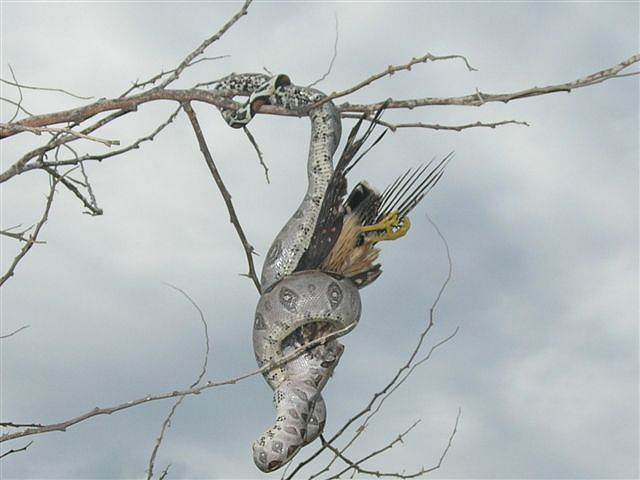
 Recently, Greg Peterson of Aruba Birdlife Conservation and Diego Marquez, ecologist at Aruba’s National Arikok Park visited Ministers Sevinger and Oduber, who are both responsible for environment and nature affairs of Aruba. The Ministers were requested to give their cooperation to a national Boa constrictor control program.
From 1999 to 2003 Park Rangers caught 273 Boas in Aruba. From 2004 to 2006 they caught 941 boas on the island. And from 2007 to 2009 they caught no less than 1781 boas in Aruba's nature. The increase in boa numbers over the years is alarming. The caught boas were euthanized with assistance of the Veterinary Department.
To illustrate the impact the boas are having on Aruba's birdlife, Peterson and Marquez created a simplified and preliminary calculation.
Based on the number of boas caught by the Rangers, they estimate that a minimum of 2000 boas are actually present in Aruba's nature. A careful estimate’ of a boa having a meal every two weeks would lead to 26 meals per boa per year.’ Research shows that boa meals in Aruba consist of 1/3 birds — 1/3 reptiles — 1/3 mammals. Through this model it can be estimated that boas in the wild consume, at present numbers, (2000 x 26 x 1/3 =) 17.333 birds a year in Aruba. The model illustrates that the same number of reptiles and mammals are consumed per year as well. If we take Aruba’s size into consideration, then the ‘Guam scenario’ is the most likely outcome if action is not taken promptly.
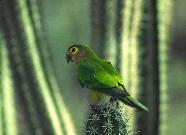
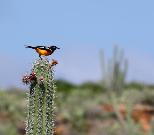
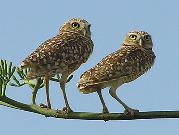
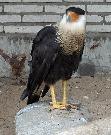
In Guam the Brown Tree Snake was introduced 30 years ago unintentionally. At present no less than 8 endemic bird species are extinct, besides other species of fauna. The Boa constrictor, on the other hand, was first registered in the wild in Aruba in April of 1999, but it breeds in larger numbers than the Brown Tree Snake. This means that it will not take 30 years to reach a similar scenario, but it will go much faster. Aruba Birdlife Conservation is convinced that an Aruba without a Troupial, Prikichi, Patrishi or Shoco, four of Aruba's beloved bird species of which 2 are endemic, is not an acceptable future scenario.
Eradication of the boa is the most desired outcome, but most likely not achievable. So the only remaining attainable strategy is to develop and implement a ‘control program’ aimed at structurally, year in, year out, keeping the Boa’s numbers as low as possible. To be able to monitor if the control program is effective enough, a yearly national bird count will be required.
Peterson and Marquez proposed to the Ministers to involve the entire community in the implementation of the Boa constrictor control program. In time, the entire population will have to learn to deal with the invasive Boa infestation as in any regular pest cases around one’s home. The Ministers showed their understanding and shared their concerns about the serious implications of the increasing numbers of boas in Aruba's wildlife and committed to appointing government officials as soon as possible to analyze the proposition and to advise them on how best to proceed.