Oranjestad – Greg Peterson, the Director of Free Zone Aruba NV reports being ecstatic about the developments. Alfonso Boekhoudt, Director of the Aruba Port Authority NV, says he is elated in view of recent breakthroughs. What makes these two pillars of the island’s economy so pleased is the final approval by the APA board of the ethanol dehydration plant within the Barcadera port.
“It proves,” says Boekhoudt with a great sense of satisfaction, “that our vision for Aruba was realistic.”
In 2005, a local company, Global Foods Holding, asked an international expert, Sergio C. Trindade, one of the most prominent experts in the world on renewable energy, especially fuel-ethanol, to conduct a feasibility study researching the establishment of an ethanol dehydration plant in the port of Barcadera.
After seriously looking at all variables, Global Foods concluded that while building the plant will have a positive impact, it must first secure a steady incoming supply of the actual ethanol, before launching its ambitious plans.
The company, in conjunction with a Brazilian partner, then set out to invest one billion US dollars in the construction of not just one but four large sugar cane mills and ethanol plants in Brazil which will secure steady incoming supply of raw material for the new Barcadera project.
If all goes well, the mills in Brazil will be operational at the end of 2008, and capable of shipping their product to Aruba by bulk carriers.
When the ethanol arrives here, it will be finished and prepared to enter consumer markets all over the world.
It will be considered a Caribbean Basin Initiative project designed to support and boost the economy of developing countries, finally allowing Aruba to participate more fully in the benefits of the global economy.
Little Aruba will then arrive on the international alternative fuel scene with an excellent, very sought-after, high-quality product.
Peterson calls this a quantum leap for the island, as Aruba will be doing business with both Brazil in South America and the USA, the European Union and the Far East, trans-shipping a whopping sixty million gallons a year. “I have been involved in this for two years,” he reveals, “and the free zone status being given to the plant in the Barcadera harbor, is very exciting news.”
Peterson reflects on the fact that Aruba has always desired to connect with Brazil, in the form of an interesting, lucrative initiative. And while the idea of doing business with South America has been around for a while, it took time to hatch. The seed of international trade was planted a number of years ago and it is now growing nicely, Peterson declares, and in ways that could not be predicted. Surely, he states, this Brazil – Aruba affiliation will beget more projects in the future. "We have finally proven the skeptics wrong", he proudly asserts.
Recently, the visiting Trindade conducted a fruitful round of talks with both Free Zone Aruba NV & APA NV. He’s met the FZA management once before, on his first visit here, for a tentative round of discussions and last week he engaged in excellent conversations with APA’s Board of Directors.
He answered all of their questions and was pleased with their warm response.
He found Alfonso Boekhoudt, APA’s General Manager, extremely helpful and enthusiastic; truly prepared to give the new free zone project blessings and backing.
During those talks, Trindade informed Aruba that the Rotterdam Harbor is also mobilizing to create a similar plant in accordance with the highest European standards in environmental matters.
Aruba’s project will draw inspirations from the Dutch blueprint and will be based on the highest safety principles, Peterson affirmed.
Overall Peterson contends that the ethanol dehydration plant is exactly the type of diversification that the free zone has been looking for. The plan represents a big change, an innovative product, which involves high tech production-lines and as such fits the objectives of the free zone’s growth aspirations.
The free zone ethanol plant represents a win-win outcome for Free Zone Aruba NV and APA NV, Peterson explains, APA will be in charge of ship movement, generating extra income and full deployment. Both the harbor and Free Zone Aruba are very happy, he concludes. Boekhoudt is of the same opinion. He states that while the investors had many options open for them in the Caribbean, they picked Aruba, which pleases him immensely because of the valuable increase in container ship traffic. “It is a huge privilege,” he says, “to be able to combine Free Zone status and harbor services, to benefit the island and its people.”
The man behind the long-term, multi-national plan are businessmen Rene Kan & Justus Martens. A number of years ago Kan & Martens created new opportunities for Aruba when under the OCT, Oversees Countries and Territories regulations, they started exporting tens of thousands of tons per year of sugar blends to the European market, becoming the Free Zone’s and the Harbor’s single biggest client, shipping containers out of Aruba.
Now again, they are launching a Caribbean Basin Initiative program, and take the lead in creating more economic activity, this time in relationship to the US.
Peterson points out that the project cleverly finds new usage for existing infrastructure, and that on an island solely reliant on tourism, diversification of the economy may hedge against possible economic downturns. “Venturing further into high tech industry,” Peterson explains, “is one of the island’s main economic goals.”
"The key to such successful projects is sincere and willing cooperation between players such as the harbor, the airport and the free zone.” In the last year and a half, Peterson reveals the relationship between these entities has improved significantly. “We see that such cooperation comes to fruition and we need more believers to get on board this moving train", Peterson asserts.
Sonny Hoo, a member of APA’s Board of Directors expresses his satisfaction with the leadership provided by Rene Kan/ Justus Martens and with the expertise offered by Trindade.
“We are very confident,” he says, “Trindade is a brilliant engineer, and Kan/Martens are proven developers, it all spells positive, compounded growth for Aruba’s economy.”
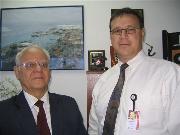
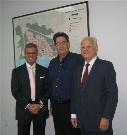
Pictured here Sergio C. Trindade, with APA NV & FZA NV executives.
As a matter of interest, Trinidade earned a PhD in chemical engineering with minors in international business and energy economics, from MIT. He designed, built and operated the first sugar hydrogenation to sorbitol plant in Latin America and later headed the international management consultancy Arthur D. Little, Inc. in Brazil. He also started the first private technology center in Brazil at PROMON, which pioneered work in new and renewable energies, especially fuel ethanol. Trindade was the United Nations Assistant Secretary-General for Science and Technology 1986-91. Since 1991, he runs a consultancy in New York, SE2T International, Ltd., and is active in sustainable development, energy, including alcohol fuels, and climate change issues. His 30 years of experience brought him to Brazil, Central America, the Caribbean, France, Indonesia, Italy, Kenya, Malawi, Mexico, Paraguay, Thailand and the USA, and he is currently involved with policies on international fuel ethanol trade in Brazil, Mexico and now also Aruba.
Kan on his part thanked the Management and Board of the Aruba Port Authority and the Aruba Freezone NV for all their time and energy, and delivered special thanks to the Government of Aruba; especially to the Prime Minister Nelson Oduber for all the support they have given the project. In a brief telephone interview, he was traveling at the time of print, Kan stated that while he is pleased with the outcome so far the project still has a long way to go: important negotiations will have to start with both APA, ASTEC and the Freezone NV on the costs involved. If Aruba is competitive, the project will be become a reality.
As a side note, Peterson also points out that besides benefiting the overall island economy the new plant may also impact the local consumer in the future. Aruban automobile and gas distributors will face the challenge of introducing the mix of gasoline and ethanol to drivers here. “If they can make it work, “Peterson declares, “It will be a cost reduction in fuel consumption and an investment opportunity for local companies.”