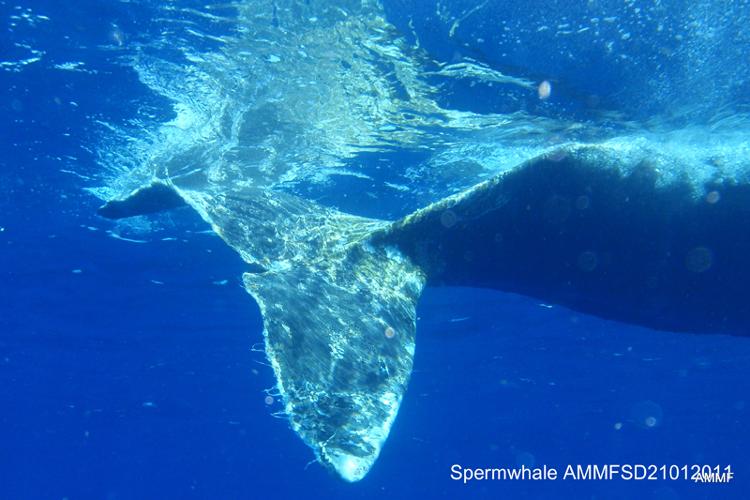
 Another dead Spermwhale drifting in Aruba waters. Found Jan 21st 2011, 9am, 4 miles from the Aruban coast. This is merely 11 days after another Spermwhale in distress was sighted an entire day close to St Maarten ‘s North East beaches before it disappeared.
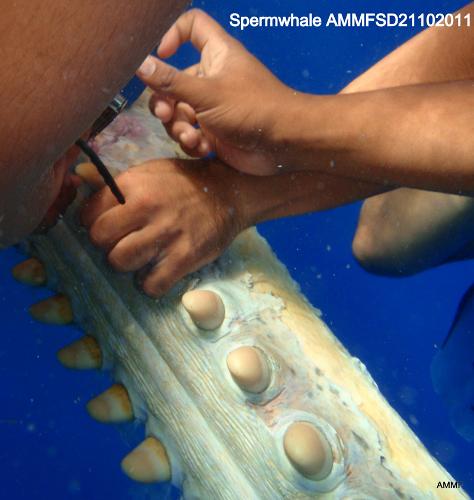
The Coastguard and AMMF in collaborated effort documented and obtained some samples for Scientific reseach contribution. A very special thanks goes to the fishing boats who reported the finding, and to the Coastguard “Steunpunt” Randolp Paskel and his staf Rowalstki Paskel (Kwartier meester) , Gino Werleman (Bootsman), Nehomar Rasmijn (Schipper), Reinold Kiringdongo (Vlop 1), Gregory Giel (Vlop 2) for their tireless efforts and loyal valuable collaboration. (Reinold and Gregory: what a wonderful job with extracting the tooth from the submerged jaw 4 miles out at sea!) Once again Aruba was united in efforts to contribute to Scientific research towards the conservation of Marine Mammals and our Ocean’s health.
The Spermwhale, (Physeter macrocephalus ), also known as Mobie Dick, was about 12m long and was in a state of decomposition indicating it was at least 4 days dead. It had two bites on its back and 1 on the right flank, and multiple bites at the jaw on the left side. The tongue wasn’t visible, a delicacy for Orcas. There were no visible indication as to the cause of death, although it had a nylon fishing line wrapped twice around its torso. Seabirds who usually feed on dead whales where absent and so where sharks.
This is the 3rd dead stranding incident of this species recorded by AMMF in Aruba.
In 2003 a dead Spermwhale entangled in Fishing Trawler’s ropes stranded near Baby Beach, and in 2010 2 dead Spermwhales were found entangled in a driftnet a couple of miles offshore.
 The Spermwhale is known to live in social groups with strong bonds. They hold the record of the deepest divers (3200m deep) and have the largest brains in the world. Their favorite food is giant squid but also eat fish, including sharks, and live in all oceans. Their lifespan is longer then 70 years. There are still about 200 000 of them left in the world. The Sperm whale is classified by the IUCN as vulnerable for extinction and is on the Appendix I of the Convention in International Trade in Endangered Species of wild Flora and Fauna (CITES).
The health of the Spermwhales is a measure of the health of our oceans. By taking dart-samples of 955 Spermwhales’ blubber, Dr Roger Payne (USA) conducted a 5 year research, covering 87 000 miles, on organic and metal pollutants of the ocean. The samples were sent for analysis to marine toxicologist John Wise at the University of Southern Maine. The result, is considered the most comprehensive ocean pollution research ever made, published in 2010 . It revealed a jaw-dropping alarming high level of contamination of metal, a.o. mercury , chromium, cadmium, all known carcinogens. Also higher then expected concentration of aluminum was found. This could mean that the ocean as a healthy food resource for humans is in danger.
Dr. Payne, 75, is best known for his 1968 discovery and recordings of songs by humpback whales, and for finding that some whale species can communicate with each other over thousands of miles. “The consequences of the metals could be horrific for both whale and man”, he said.