courtesy of: The Morning News
Fiesta di San Juan y Dera Gai is an Aruban tradition celebrated every year on June 24. History tells that San Juan festivities originated on the South part of Mexico and came down to Guatemala and other countries in Central America reaching Venezuela and passed down to Aruba.
It is a custom brought by the missionaries who evangelized the villages, by introducing a tradition for the remembrance to the sacrifice of apostle San Juan Bautista, who according to the Biblical history was decapitated by order of King Herodes, since he liked princess Salomé.
When the Spanish ruled the island, they brought a couple of missionaries to educate the locals about Christianity. The place they started to preach is where the Alto Vista Chapel is situated now. The first 2 missionaries are still to be found buried on the right front side of the chapel entrance. The missionaries allowed the natives by then to preserve some of their pagan celebrations like Dera Gai, Dande and the Carnival. That is why they combined the harvesting cele- bration with Saint John day.
Aruba celebrates San Juan in a unique way. San Juan festivities in the early times had to do more with superstition. Mainly because the natives believed in spirits and several Gods, and they were very afraid of them. In order to be in the good grace of the Gods and spirits, they had to make several offerings. One of these was for the harvest. The purpose of the festival of harvest was to thank the many Gods for the good harvest year and to request them to bless the harvests for the following year.
In early times cunukeronan (coo-noo-ker-o-nan, Aruban farmers) after harvesting, they stored the trunks of the several plants like corn and other types of wood, so that they could be burned on San Juan (Saint John's Day). The farmers would then burn the woods, on the night before San Juan as well as throughout the day. Fire means purification and it scares away bad luck resulting in a better harvest the following year.
During the festivities, there were several games like jumping over fire, typical dances, singing, stories and joked being told, all this done around the fire. This festivity was something big in Aruba - it was a holiday. In the past, on June 23rd workers were given the afternoon off and the June 24 the whole day. The festivities start when the night arrives on San Juan's Eve.
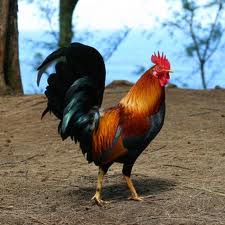
The tradition to bury a living rooster (dera = bury and gai = rooster) was very common in those days. Nowadays it is obviously unthinkable to do such a thing.
Every town had it's own festivity. The most important dance was where a rooster is buried leaving only it's head above the ground. Over the years this has been replaced with a calabash gourd, and nowadays a synthetic rooster is placed above the ground. A man is then selected from the crowd and is blindfolded. He is then asked to kill the rooster by hitting its head real hard with a stick.
After the incorporation of San Juan, they expanded the tradition, where now men named Juan have preference over the others. The man is spinned around so that he get disoriented and no longer knows the exact location of the rooster. Then with a corn stick, he has to hit the rooster's head. He has 3 chances, and if he misses another man is given the opportunity. An experienced dancer is guided by the wind and uses his foot to feel the ground in search of the rooster, because as a rule you are not to feel the ground with the stick.
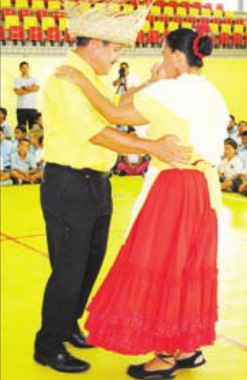
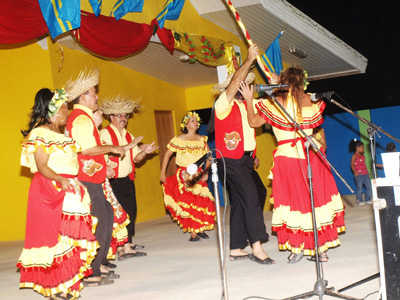
During these festivities, women are dressed with long yellow dresses and yellow hair holders dancing in a choreographed manner. The musicians are dressed in yellow or red with a colorful band tightened on their hips. The instruments used consist mostly of drums and other noisemaker devices. While the music plays, the dancer has to hit the rooster, but the stick is not to touch the ground, or he looses his turn. This is done to symbolize the three times the rooster sang when Saint Peter lied about not knowing Jesus, according to the bible.
Up to this day, Dera Gai is still celebrated in every town. Needless to say that the fire department has their hands very full putting out some of the fires that get out of hand.