 courtesy of: The Morning News
by Rosalie Klein
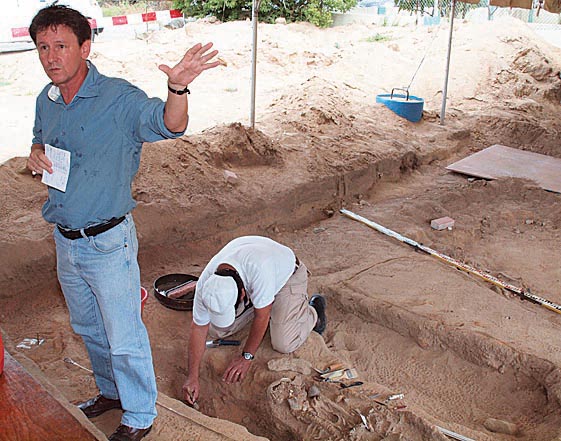
Aruba’s archaeological team, headed by Raymundo Dijkhoff, announced that the dig located behind the offices of Notary Tromp in Santa Cruz is harvesting some startling revelations and mysteries to be unraveled by historians.
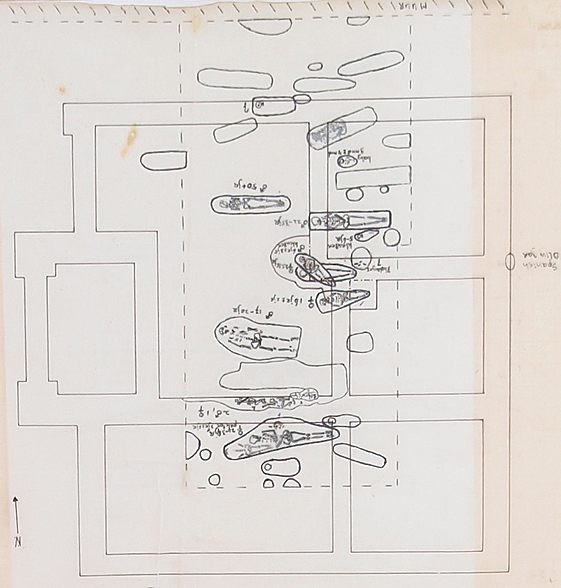
The unmarked burial site, which was discovered by accident when the property owners began bulldozing to build a parking lot in 2002, has yielded to date 33 graves without any sort of marker or tombstone of any kind.
Uncovered remains are a puzzle, as artifacts accompanying them indicate a diversity of techniques, from Christian burial to Amerindian traditions, complete with grave gifts, and through Carbon dating, they have been able to pinpoint at least two eras of burial, a Spanish period, 1515-1636 A.D and a colonial period from 1792 to 1924 A.D.
The earlier period particularly creates something of a mystery according to island historian Luc Alofs, as during that time, settlements east of the Hooiberg were forbidden; the land was reserved as grazing areas for cattle and there is no record of nearby settlements. Such a collection of graves would indicate the existence of a house of worship adjacent.
Presently, only 60 square meters of gravesite has been uncovered, but those working the site and Mr. Alofs are quite convinced it likely extends beyond the present parameters.
Certain Spanish artifacts, such as one of three olive jars found on the island, help to pinpoint the origins of some of the graves, as well as a silver coin, likely mined in Bolivia and minted in Peru, which was common currency of the Spanish in the Caribbean during the 1500’s.
Certain distinctive characteristics of the remains indicate a number of them to be Amerindian; the fact they are buried side by side with obvious Christian burials raises several interesting questions. DNA testing will allow those investigating the site to better pinpoint the nation of origin of each of the remains, their commercial and community status.
Quite a few of the graves are infants and young children; the scientists acknowledged that malnutrition was a common problem contributing to infant mortality at the time, which was about 11%.
During the estimated time of burial, Aruba’s churches and gravesites were administrated by the Archdiocese out of Venezuela; it is hoped by investigating their records, the mystery of this burial ground will be solved.
In the month of March, 2012, another 9 graves were exposed, one including a woman buried with 2 children. The scientific team of Aruba’s National Archaeological Museum in Oranjestad working under Raymundo Dijkhoff is Harold Kelly, Francisco Croes, and Hiram Angela.
The museum expressed their gratitude to the Ministries of Infrastructure and Culture and to Notary Tromp for their support of this project, which is hoped with shed light on some of the gaps in Aruba’s recorded history.