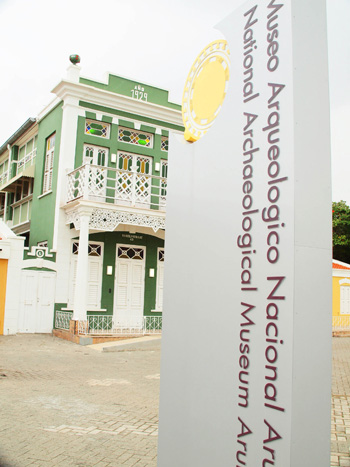
courtesy of: The Morning News
written by: Rosalie Klein
An impromptu gathering of press and staff members of NAMA celebrated the 30th anniversary of the founding of the museum on December 20, 1981. Head Administrator Arminda Ruiz and Marguerita Wever of the Educational Department welcomed visitors and press to the Rosenberg House in the complex to unveil a new page added to their website in English: www.namaruba.org in honor of the occasion. The addition provides a timeline of the formalized study of archeology on Aruba, and the many steps along the way that led to the unique facility which officially opened in 2009.
It is a Dutch Catholic priest, Father Antonious Joannes van Koolijk, who is considered the founder of archeological studies both here in Aruba and Curacao. Stationed to the islands in 1880, he was “an enthusiastic field worker and keen observer,” with particular interest in the history and culture of the local Amerindians. He sent a number of artifacts to the National Museum of Antiquities in Leiden during his tenure, 5 of which can be seen now at MANA.
When Dutch archeologist Egbert Boearstra came to the Dutch Caribbean to explore and excavate, he settled in Aruba, declaring it “the most archeologically rich island of all.” Under the auspices of the Minister of Culture at the that time, he crafted the first organized collection of local Pre-Ceramic artifacts which opened at Zoutmanstraat #1, one of the first such museums to be established in the Caribbean, 30 years ago yesterday, to the day.
In 1988, talented graphic artist Evelino Fingal, the designer of Aruba’s money, lead a new generation enthusiastic about unearthing and sharing Aruba’s ancient heritage; it was he who originally conceptualized and proposed the acquisition of the Ecury Complex in Oranjestad to house a national Archeological Museum. His vision was realized with assistance from the European Union.
For an interterm period, the museum was located within the confines of the Instituto di Cultura, while the plans and details of this final facility were processed. Since officially opening in July of 2009, the museum has attracted over 20,000 visitors and this attractive location has been the site of a number of community events, particularly aimed at stimulating island youth to take an interest in their cultural and historic heritage.
A new exhibit is in the making, as well as two publications coming out within the year, and several more events for youngsters. Arminda Ruiz pointed out that excavating the foundation of a new annex to the Government House revealed several artifacts from colonial times, which the museum is now evaluating. “These materials are iron, and are really not within the timeline to which are museum is dedicated, but their discovery has presented us with some very interesting new challenges. Ultimately, they may end up at the Historical Museum within Fort Zoutman, or ideally, in my opinion, would make a wonderful way to greet visitors to the new annex, with a display of these important artifacts found at the site.”
Visitors are welcome to the Aruba National Archeological Museum Tuesday through Friday from 10:00 AM to 5:00 PM and Saturdays and Sundays from 10:00 AM to 2:00 PM.