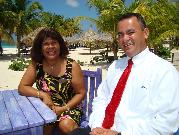
 AHATA Headquarters – Last July, Aruba officially adopted the Blue Flag initiative under the leadership of the Aruba Hotel and Tourism Association (AHATA) and in close cooperation with the Aruban government. The Blue Flag Program, part of a non-profit organization called Foundation for Environmental Education (FEE), works towards sustainable development at beaches and marinas throughout the world. With the raising of blue flags on the island's beaches, Aruba will join the other Caribbean islands—the Bahamas, Dominican Republic, Jamaica, and Puerto Rico—that boast managed beach care and nature preservation while providing greater services and other benefits for the users.
FEE is holding a special Blue Flag event, the Beaches World Tour Conference, in Toronto, Canada from October 9 to October 11. The event will also celebrate the 20th anniversary of the Blue Flag Program. During the conference, leading specialists will discuss efforts to create solutions to key issues affecting beaches worldwide, such as climate change and tourism. Experts from 20 different countries will present successful cases of improved management and protection in areas affected by these key issues. Astrid Muller, General Manager of the Divi Phoenix and Chair of AHATA's Environmental Committee, will attend the conference on Aruba's behalf. Astrid is working hard alongside Byron Boekhoudt, government representative of the Coastal Zone Management project team, in order to successfully launch the Blue Flag Program on the island. The knowledge and insight Astrid gains at the Toronto conference will surely refuel the effort.
Before a beach or marina can earn the Blue Flag stamp of approval, it must meet specific criteria dealing with environmental education and information, water quality, environmental management, safety, and other services. For example, a Blue Flag beach must comply with the standards for excellent bathing water quality, must be equipped with waste disposal and recycling bins as well as a supply of potable drinking water, and must have access to toilet facilities. Also, signs must be posted in order to inform the public of beach regulations as well as the presence of turtle and bird nests and protected coral reefs located at a Blue Flag beach.
FEE requires that its members be non-profit, non-governmental, independent organizations with the primary objectives of environmental education and protection. For now, AHATA will represent Aruba, but within two years of last July AHATA will hand over the reins of the Blue Flag project to a group that is still in formation on the island. This group, the Coastal Zone Management (CZM) of Aruba, will then serve as the official member of FEE on Aruba's behalf. CZM will be comprised of stakeholders which come from three different groups: the government, the private sector (AHATA), and environmental non-government organizations (such as Parke Nacional Arikok, Stima Aruba, and Tortuga Aruba). A foundation will manage the funding of the Blue Flag Program and other marine resource preservation efforts on the island. Funding for the program is being provided in part by the Fondo Desaroyo Aruba (FDA) as well as other sources.
Most of the program policies have already been drafted, and the majority of the program plans have been completed. As soon as the funds are sufficient, the Blue Flag Program will begin to materialize on several of Aruba's beaches. Arashi, Baby Beach, and Mangel Halto will be tackled in the pilot phase of the program. As soon as these beaches are brought up to Blue Flag standards, beaches that face greater challenges, such as Eagle Beach and Palm Beach, will be targeted. The idea is that once the pilot phase clearly demonstrates the benefits and advantages of the managed beach care concept to all involved, the concept will quickly be adapted at other locations. Once the ball is rolling, support for the concept of managed beach care and CZM issues will also increase. The intention is to see a blue flag go up, beach by beach, until the entire island is Blue Flag certified. Both locals and visitors will enjoy cleaner, safer beaches, and the exclusive Blue Flag eco-label will carry with it excellent tourism marketing benefits, thus providing for a win-win private-public partnership.
Fortunately, Aruba's beaches are starting with a clear advantage as they enter the Blue Flag Program. Aruba already meets and even surpasses certain Blue Flag criteria; its beaches boast high-quality water, it has good infrastructure, and it already implements a wide variety of environmental education activities. Soon—perhaps as early as the middle of next year—Aruba's residents and guests will begin to see the changes mandated by the Blue Flag Program on the island's pilot beaches.